Interrogatory responses
Answers to questions 2 thru 20
Files10
OCC Response to CIEC Second Set of Requests.pdf
PDF · 571 KB · 25 pagesText searchable
Download OCC Response to CIEC Second Set of Requests.pdfRead the text of OCC Response to CIEC Second Set of Requests.pdf
Response to CIEC-2 (a) Classification of AMI-related costs.xlsx
Excel · 16 KBText searchable
Download Response to CIEC-2 (a) Classification of AMI-related costs.xlsxRead the text of Response to CIEC-2 (a) Classification of AMI-related costs.xlsx
Response to CIEC-8 (b) Allocation of AMI meter costs.xlsx
Excel · 16 KBText searchable
Download Response to CIEC-8 (b) Allocation of AMI meter costs.xlsxRead the text of Response to CIEC-8 (b) Allocation of AMI meter costs.xlsx
CIEC-9 (d) Attachment A C17-0556_16A-0588E.pdf
PDF · 177 KB · 16 pagesText searchable
Download CIEC-9 (d) Attachment A C17-0556_16A-0588E.pdfRead the text of CIEC-9 (d) Attachment A C17-0556_16A-0588E.pdf
CIEC-9 (d) Attachment B 2023-CO-Phase-II-Electric-Rate-Review-Decision.pdf
PDF · 476 KB · 45 pagesText searchable
Download CIEC-9 (d) Attachment B 2023-CO-Phase-II-Electric-Rate-Review-Decision.pdfRead the text of CIEC-9 (d) Attachment B 2023-CO-Phase-II-Electric-Rate-Review-Decision.pdf
CIEC-12 Attachment - Bonbright Excerpt.pdf
PDF · 136 KB · 4 pagesText read by machine from a scan; may contain errors, especially in numbers
Download CIEC-12 Attachment - Bonbright Excerpt.pdfScanned pages and text of CIEC-12 Attachment - Bonbright Excerpt.pdf
CIEC-13 (a) Attachment - rate_order_Hydro One DX 2013_20121220.pdf
PDF · 245 KB · 31 pagesText searchable
Download CIEC-13 (a) Attachment - rate_order_Hydro One DX 2013_20121220.pdfRead the text of CIEC-13 (a) Attachment - rate_order_Hydro One DX 2013_20121220.pdf
CIEC-13 (d) - Hydro One Density Study HONI_APPL_Exhibit D_20120615.pdf
PDF · 3.3 MB · 99 pagesText searchable
Download CIEC-13 (d) - Hydro One Density Study HONI_APPL_Exhibit D_20120615.pdfRead the text of CIEC-13 (d) - Hydro One Density Study HONI_APPL_Exhibit D_20120615.pdf
CIEC-20 (d) Attachment 1 - PG&E Rate B-20.pdf
PDF · 1.9 MB · 24 pagesText searchable
Download CIEC-20 (d) Attachment 1 - PG&E Rate B-20.pdfRead the text of CIEC-20 (d) Attachment 1 - PG&E Rate B-20.pdf
CIEC-20 (d) Attachment 2 - PSCo Schedule PG.pdf
PDF · 198 KB · 3 pagesText searchable
Download CIEC-20 (d) Attachment 2 - PSCo Schedule PG.pdfRead the text of CIEC-20 (d) Attachment 2 - PSCo Schedule PG.pdf
Text of CIEC-9 (d) Attachment A C17-0556_16A-0588E.pdf
Extracted from the file · 16 pages · 28,745 characters
Text of CIEC-9 (d) Attachment B 2023-CO-Phase-II-Electric-Rate-Review-Decision.pdf
Extracted from the file · 45 pages · 89,290 characters
Scanned pages and machine-read text of CIEC-12 Attachment - Bonbright Excerpt.pdf
The scanned page Machine-read text
Principles of Public Utility Rates by JAMES C. BONBRIGHT NEW YORK COLUMBIA UNIVERSITY PRESS
The scanned page Machine-read text
Clothbound editions of Columbia University Press books are Smyth-sewn and printed on permanent and durable acid-free paper. SBN 231-02441-X Library of Congress Catalog Card Number: 61-6569 Copyright © 1961 Columbia University Press Printed in the United States of America 10 9 8
The scanned page Machine-read text
FULLY DISTRIBUTED COSTS 347 actual rates of charge for service, as it actually does have in some rates, there would result a three-part rate for any one class of service. For example, the monthly bill of a residential consumer might be the sum of a $1 customer charge, a $5 charge for 250 kilowatt-hours of energy at 2¢ per kilowatt-hour, and a $2 charge for a maximum demand of 2 kilowatts during the month at the rate of $1 per kilowatt—a total bill of $8 for that month. But our present interest lies in the measurement of costs of service, and only indirectly in rates that may or may not be designed to cover these costs. Let us therefore consider each of the three types of cost in turn, recognizing that this simplified classification is used only for illustrative purposes; costs actually vary in much more complex ways. 1. THE CUSTOMER COSTS These are those operating and capital costs found to vary with number of customers regardless, or almost regardless, of power consumption. Included as a minimum are the costs of metering and billing along with whatever other expenses the company must incur in taking on another consumer. These minimum costs may come to $1 per month, more or less, for residential and small commercial customers, although they are substantially higher for large industrial users, who require more costly connections and metering devices. While costs on this order are sometimes separately charged for in residential and commercial rates, in the form of a mere "service charge," they are more frequently wholly or partly covered by a minimum charge which entitles the consumer to a very small amount of gas or electricity with no further payment. But the really controversial aspect of customer-cost imputation arises because of the cost analyst's frequent practice of including, not just those costs that can be definitely earmarked as incurred for the benefit of specific customers but also a substantial fraction of the annual maintenance and capital costs of the secondary (low-voltage) distribution system—a fraction equal to the estimated annual costs of a hypothetical system of minimum capacity. This minimum capacity is sometimes determined by the smallest sizes of conductors deemed adequate to maintain voltage and to keep from falling of their own weight. In any case, the annual costs of this phantom, minimum-sized distribution system are treated as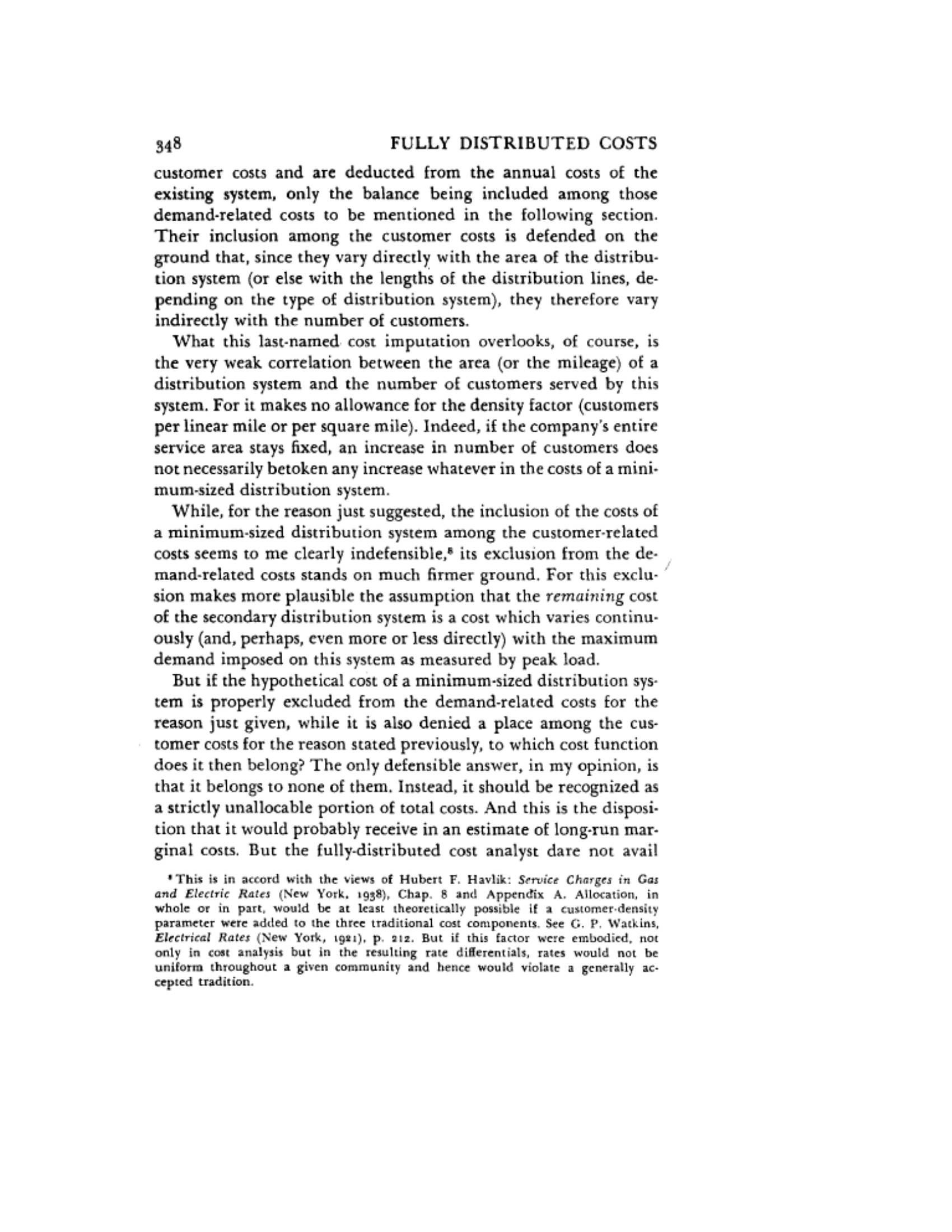
The scanned page Machine-read text
348 FULLY DISTRIBUTED COSTS customer costs and are deducted from the annual costs of the existing system, only the balance being included among those demand-related costs to be mentioned in the following section. Their inclusion among the customer costs is defended on the ground that, since they vary directly with the area of the distribution system (or else with the lengths of the distribution lines, depending on the type of distribution system), they therefore vary indirectly with the number of customers. What this last-named cost imputation overlooks, of course, is the very weak correlation between the area (or the mileage) of a distribution system and the number of customers served by this system. For it makes no allowance for the density factor (customers per linear mile or per square mile). Indeed, if the company's entire service area stays fixed, an increase in number of customers does not necessarily betoken any increase whatever in the costs of a minimum-sized distribution system. While, for the reason just suggested, the inclusion of the costs of a minimum-sized distribution system among the customer-related costs seems to me clearly indefensible,⁸ its exclusion from the demand-related costs stands on much firmer ground. For this exclusion makes more plausible the assumption that the *remaining* cost of the secondary distribution system is a cost which varies continuously (and, perhaps, even more or less directly) with the maximum demand imposed on this system as measured by peak load. But if the hypothetical cost of a minimum-sized distribution system is properly excluded from the demand-related costs for the reason just given, while it is also denied a place among the customer costs for the reason stated previously, to which cost function does it then belong? The only defensible answer, in my opinion, is that it belongs to none of them. Instead, it should be recognized as a strictly unallocable portion of total costs. And this is the disposition that it would probably receive in an estimate of long-run marginal costs. But the fully-distributed cost analyst dare not avail ⁸This is in accord with the views of Hubert F. Havlik: *Service Charges in Gas and Electric Rates* (New York, 1998), Chap. 8 and Appendix A. Allocation, in whole or in part, would be at least theoretically possible if a customer-density parameter were added to the three traditional cost components. See G. P. Watkins, *Electrical Rates* (New York, 1921), p. 212. But if this factor were embodied, not only in cost analysis but in the resulting rate differentials, rates would not be uniform throughout a given community and hence would violate a generally accepted tradition.
Text of CIEC-13 (a) Attachment - rate_order_Hydro One DX 2013_20121220.pdf
Extracted from the file · 31 pages · 41,898 characters
Text of CIEC-13 (d) - Hydro One Density Study HONI_APPL_Exhibit D_20120615.pdf
Extracted from the file · 99 pages · 204,526 characters
Text of CIEC-20 (d) Attachment 1 - PG&E Rate B-20.pdf
Extracted from the file · 24 pages · 63,774 characters
Text of CIEC-20 (d) Attachment 2 - PSCo Schedule PG.pdf
Extracted from the file · 3 pages · 7,608 characters
As listed on the current system
Question(s) Answered 2 thru 20 (OCC) Date Filed: 11/12/2026