Prefiled testimony
Witness: Dr. William Taylor
Files10
Will Taylor PFT Docket No. 26-05-10 (Acadia Center).pdf
PDF · 493 KB · 48 pagesText searchable
Download Will Taylor PFT Docket No. 26-05-10 (Acadia Center).pdfRead the text of Will Taylor PFT Docket No. 26-05-10 (Acadia Center).pdf
Ex. WOT-1_Resume.pdf
PDF · 207 KB · 6 pagesText searchable
Download Ex. WOT-1_Resume.pdfRead the text of Ex. WOT-1_Resume.pdf
Ex. WOT-2_Outlier_calculation_notebook.pdf
PDF · 350 KB · 2 pagesText read by machine from a scan; may contain errors, especially in numbers
Download Ex. WOT-2_Outlier_calculation_notebook.pdfScanned pages and text of Ex. WOT-2_Outlier_calculation_notebook.pdf
Ex. WOT-3_Ratepayer impact calculations.pdf
PDF · 3.9 MB · 18 pagesText read by machine from a scan; may contain errors, especially in numbers
Download Ex. WOT-3_Ratepayer impact calculations.pdfScanned pages and text of Ex. WOT-3_Ratepayer impact calculations.pdf
Ex. WOT-4_Acadia Center FERC Docket No ER26-2389-000 Initial Paper Hearing Brief.pdf
PDF · 498 KB · 56 pagesText searchable
Download Ex. WOT-4_Acadia Center FERC Docket No ER26-2389-000 Initial Paper Hearing Brief.pdfRead the text of Ex. WOT-4_Acadia Center FERC Docket No ER26-2389-000 Initial Paper Hearing Brief.pdf
Ex. WOT-5_BLS total factor productivity by major sectors.xlsx
Excel · 180 KBText searchable
Download Ex. WOT-5_BLS total factor productivity by major sectors.xlsxRead the text of Ex. WOT-5_BLS total factor productivity by major sectors.xlsx
Ex. WOT-6_BLS total factor productivity by major industries.xlsx
Excel · 9.3 MBText searchable
Download Ex. WOT-6_BLS total factor productivity by major industries.xlsxRead the text of Ex. WOT-6_BLS total factor productivity by major industries.xlsx
Ex. WOT-7_Acadia Center FERC Docket No ER26-2389-000 Response Brief.pdf
PDF · 422 KB · 49 pagesText searchable
Download Ex. WOT-7_Acadia Center FERC Docket No ER26-2389-000 Response Brief.pdfRead the text of Ex. WOT-7_Acadia Center FERC Docket No ER26-2389-000 Response Brief.pdf
Ex. WOT-8_Pacific Northwest National Laboratory TFP Best Practices Presentation.pdf
PDF · 609 KB · 26 pagesText searchable
Download Ex. WOT-8_Pacific Northwest National Laboratory TFP Best Practices Presentation.pdfRead the text of Ex. WOT-8_Pacific Northwest National Laboratory TFP Best Practices Presentation.pdf
Ex. WOT-9 BLS productivity calculations.pdf
PDF · 27 KB · 1 pageText searchable
Download Ex. WOT-9 BLS productivity calculations.pdfRead the text of Ex. WOT-9 BLS productivity calculations.pdf
Scanned pages and machine-read text of Ex. WOT-2_Outlier_calculation_notebook.pdf
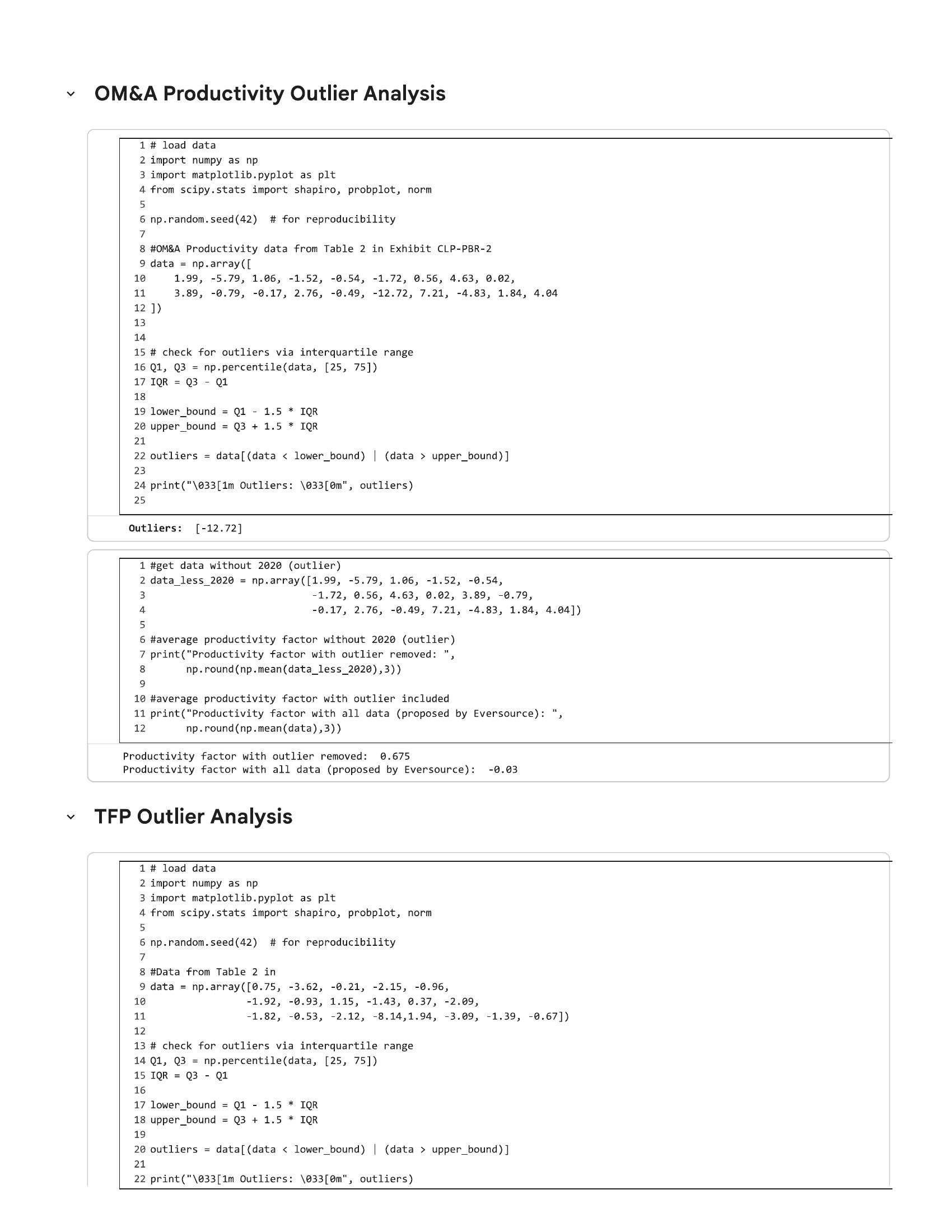
The scanned page Machine-read text
OM&A Productivity Outlier Analysis 1 # load data 2 import numpy as np 3 import matplotlib.pyplot as plt 4 from scipy.stats import shapiro, probplot, norm 5 6 np.random.seed(42) # for reproducibility 7 8 #OM&A Productivity data from Table 2 in Exhibit CLP-PBR-2 9 data = np.array([ 10 1.99, -5.79, 1.06, -1.52, -0.54, -1.72, 0.56, 4.63, 0.02, 11 3.89, -0.79, -0.17, 2.76, -0.49, -12.72, 7.21, -4.83, 1.84, 4.04 12 ]) 13 14 15 # check for outliers via interquartile range 16 Q1, Q3 = np.percentile(data, [25, 75]) 17 IQR = Q3 - Q1 18 19 lower_bound = Q1 - 1.5 * IQR 20 upper_bound = Q3 + 1.5 * IQR 21 22 outliers = data[(data < lower_bound) | (data > upper_bound)] 23 24 print("\033[1m Outliers: \033[0m", outliers) 25 Outliers: [-12.72] 1 #get data without 2020 (outlier) 2 data_less_2020 = np.array([1.99, -5.79, 1.06, -1.52, -0.54, 3 -1.72, 0.56, 4.63, 0.02, 3.89, -0.79, 4 -0.17, 2.76, -0.49, 7.21, -4.83, 1.84, 4.04]) 5 6 #average productivity factor without 2020 (outlier) 7 print("Productivity factor with outlier removed: ", 8 np.round(np.mean(data_less_2020),3)) 9 10 #average productivity factor with outlier included 11 print("Productivity factor with all data (proposed by Eversource): ", 12 np.round(np.mean(data),3)) Productivity factor with outlier removed: 0.675 Productivity factor with all data (proposed by Eversource): -0.03 TFP Outlier Analysis 1 # load data 2 import numpy as np 3 import matplotlib.pyplot as plt 4 from scipy.stats import shapiro, probplot, norm 5 6 np.random.seed(42) # for reproducibility 7 8 #Data from Table 2 in 9 data = np.array([0.75, -3.62, -0.21, -2.15, -0.96, 10 -1.92, -0.93, 1.15, -1.43, 0.37, -2.09, 11 -1.82, -0.53, -2.12, -8.14,1.94, -3.09, -1.39, -0.67]) 12 13 # check for outliers via interquartile range 14 Q1, Q3 = np.percentile(data, [25, 75]) 15 IQR = Q3 - Q1 16 17 lower_bound = Q1 - 1.5 * IQR 18 upper_bound = Q3 + 1.5 * IQR 19 20 outliers = data[(data < lower_bound) | (data > upper_bound)] 21 22 print("\033[1m Outliers: \033[0m", outliers)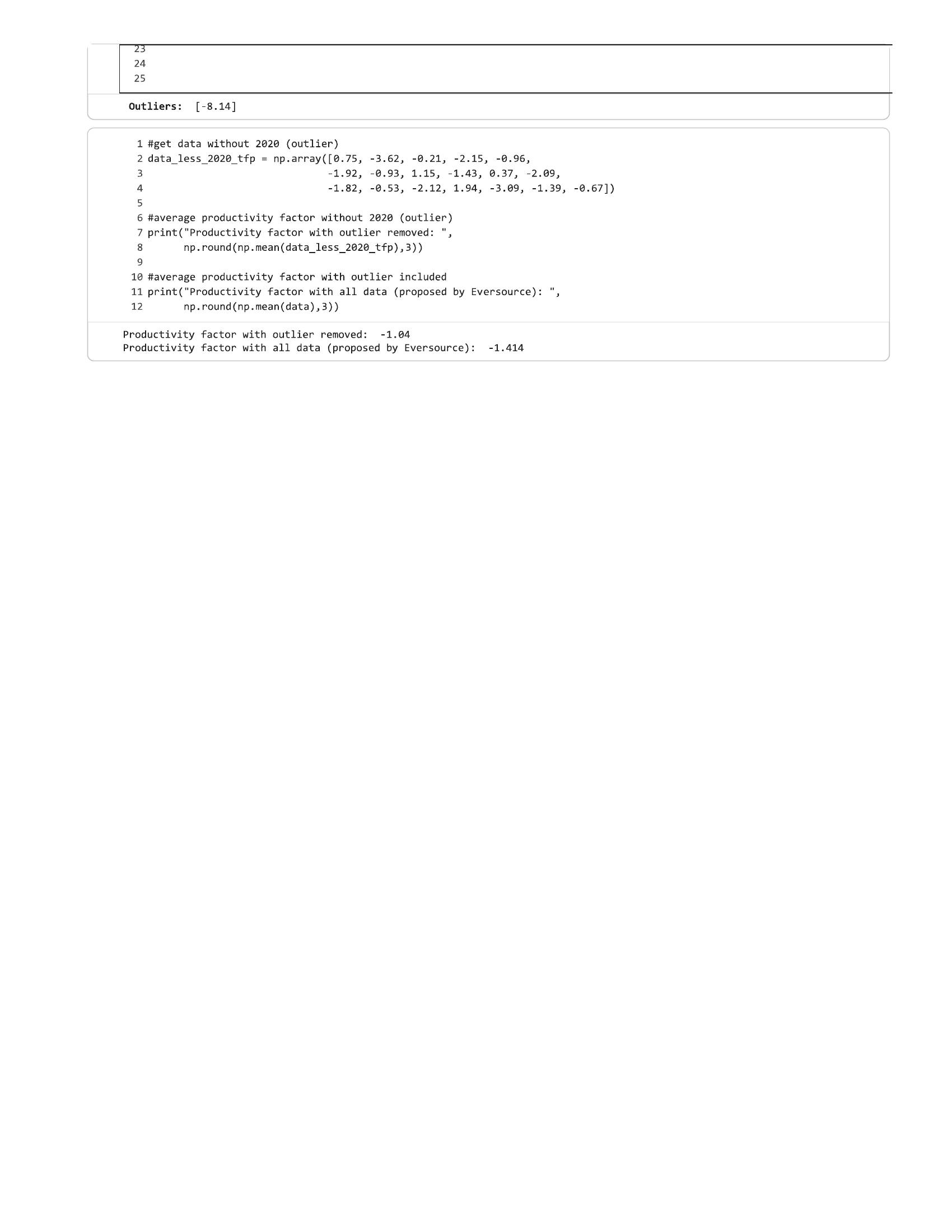
The scanned page Machine-read text
23 24 25 Outliers: [-8.14] 1 #get data without 2020 (outlier) 2 data_less_2020_tfp = np.array([0.75, -3.62, -0.21, -2.15, -0.96, 3 -1.92, -0.93, 1.15, -1.43, 0.37, -2.09, 4 -1.82, -0.53, -2.12, 1.94, -3.09, -1.39, -0.67]) 5 6 #average productivity factor without 2020 (outlier) 7 print("Productivity factor with outlier removed: ", 8 np.round(np.mean(data_less_2020_tfp),3)) 9 10 #average productivity factor with outlier included 11 print("Productivity factor with all data (proposed by Eversource): ", 12 np.round(np.mean(data),3)) Productivity factor with outlier removed: -1.04 Productivity factor with all data (proposed by Eversource): -1.414
Scanned pages of Ex. WOT-3_Ratepayer impact calculations.pdf
Read by machine from a scan · 18 pages · may contain errors, especially in numbers
Page 4 of 56
Hanser, Philip Q., Affidavit of Philip Q. Hanser in Response to the Testimony of Adrien M. McKenzie (Exhibit No. PTO-100) on Behalf of Acadia Center, Ex. No. AC100, Docket No. ER26-2389-000 (FERC Aug. 28, 2026) .........................................passim Lesser, Jonathan A., Affidavit on Behalf of the New England Consumer-Owned Systems, Ex. No. NEC-001, Docket No. ER26-2389-000 (FERC May 21, 2026) .......................... 29 Maine Office of the Public Advocate, Protest and Request for Partial Summary Disposition, Docket No. ER26-2389-000 (FERC May 21, 2026) .................................... 29 McKenzie, Adrien M., Direct Testimony and Exhibits of Adrien M. McKenzie, CFA on Behalf of the Participating Transmission Owners Administrative Committee, Ex. No. PTO-100, Docket No. ER26-2389-000 (FERC Apr. 30, 2026) ..........................passim New England Consumer-Owned Systems & Energy New England, LLC, Motion to Intervene, Protest and Request for Evidentiary Hearing, Docket No. ER26-2389000 (FERC May 21, 2026) ................................................................................................ 29 New England Transmission Owners, Motion for Leave to Answer and Answer of the New England Transmission Owners, Docket No. ER26-2389 (FERC June 5, 2026) ................. 6 Participating Transmission Owners Administrative Committee, Proposed Revisions to Attachment F of the ISO New England Inc. Open Access Transmission Tariff to Update the Return on Equity, Docket No. ER26-2389 (FERC Apr. 30, 2026) .................. 2 Public Systems, Motion to Intervene and Protest, Docket No. ER26-2389-000 (FERC May 21, 2026) ................................................................................................................... 29 State Entities, Protest and Request for Maximum Suspension, Refund Protection, and Hearing and Settlement Procedures, Docket No. ER26-2389-000 (FERC May 21, 2026) ................................................................................................................................. 29 Other Authorities Adrian, Tobias, Richard K. Crump & Emanuel Moench, Regression-Based Estimation of Dynamic Asset Pricing Models, 118 J. Fin. Econ. 211 (2015) ......................................... 31 Alquist, Ron, Ronen Israel & Tobias J. Moskowitz, Fact, Fiction, and the Size Effect, 45 J. Portfolio Mgmt. 34 (2018) ............................................................................................. 25 Damodaran, Aswath, Corporate Finance: Lecture Note Packet 1—Management Objectives and Investment Analysis (N.Y.U. Stern Sch. of Bus., Spring 2026) ................. 5 iiiPage 5 of 56
Damodaran, Aswath, Data Update 2 for 2026: Equities Get Tested, and Pass Again!, Musings on Markets (Jan. 23, 2026) ......................................................................... 21-22, 25, 31-32, 41, 49 Damodaran, Aswath, Implied Equity Risk Premium by Month, N.Y.U. Stern Sch. of Bus. ........ 22 Duarte, Fernando & Carlo Rosa, The Equity Risk Premium: A Review of Models, 21 Fed. Rsrv. Bank N.Y. Econ. Pol’y Rev. 39 (2015) ................................................................... 31 Hamada, Robert S., The Effect of the Firm’s Capital Structure on the Systematic Risk of Common Stocks, 27 J. Fin. 435 (1972) ............................................................................... 8 ISO-NE, Transmission, Mkts., and Servs. Tariff, § II, attach. F, app. A (ATRR Template), worksheet 2, note (b) (31.0.0) ........................................................................... 2 J.P. Morgan Asset Management, 2026 Long-Term Capital Market Assumptions: TimeTested Projections to Build Stronger Portfolios (2025) ............................................. 22, 41 Kroll, Recommended U.S. Equity Risk Premium and Corresponding Risk-Free Rates to Be Used in Computing Cost of Capital: January 2008–Present (Apr. 30, 2026) ........................... 23-25, 41 Otter Tail Corp., Annual Report (Form 10-K) (fiscal year ended Dec. 31, 2025) (filed Feb. 18, 2026) .................................................................................................................... 15 Rode, David C. & Paul S. Fischbeck, Regulated Equity Returns: A Puzzle, 133 Energy Pol’y 110891 (2019) ............................................................................... 7, 24, 32-33, 36-37 Shumway, Tyler, The Delisting Bias in CRSP Data, 52 J. Fin. 327 (1997) ................................. 25 van Dijk, Mathijs A., Is Size Dead? A Review of the Size Effect in Equity Returns, 35 J. Banking & Fin. 3263 (2011) ............................................................................................. 25 ivPage 6 of 56
TABLE OF EXHIBITS Exhibit No. AC-100 Sponsoring Party Philip Q. Hanser AC-101 Philip Q. Hanser Description Affidavit of Philip Q. Hanser in Response to the Testimony of Adrien M. McKenzie (Exhibit No. PTO100), including Attachment A, Curriculum Vitae Attachment B: Supporting Workpapers of Philip Q. Hanser and Reproduced Source Material, including native Excel workpapers vPage 7 of 56
GLOSSARY OF TERMS TERM Bloomberg CAPM Commission CRSP DCF EPS ERP FPA GDP IBES ISO-NE MRP NETOs OATT PTOs DEFINITION Bloomberg Terminal / Bloomberg Professional Service Capital Asset Pricing Model Federal Energy Regulatory Commission Center for Research in Security Prices Discounted Cash Flow Earnings Per Share Equity Risk Premium Federal Power Act Gross Domestic Product Institutional Brokers’ Estimate System ISO New England Market Risk Premium Central Maine Power Company, Eversource Energy Service Company, on behalf of The Connecticut Light and Power Company, NSTAR Electric Company, and Public Service Company of New Hampshire, Fitchburg Gas and Electric Light Company, The Narragansett Electric Company d/b/a Rhode Island Energy, New England Power Company d/b/a National Grid, New Hampshire Transmission, LLC, The United Illuminating Company, Unitil Energy Systems, Inc., and Versant Power. Open Access Transmission Tariff NETOs plus Chicopee Municipal Lighting Plant; Connecticut Municipal Electric Energy Cooperative; Connecticut Transmission Municipal Electric Energy Cooperative; Green Mountain Power Corporation; Maine Electric Power Company; Massachusetts Municipal Wholesale Electric Company; New Hampshire Electric Cooperative, Inc.; Shrewsbury Electric and Cable Operations; Taunton Municipal Lighting Plant; The City of Holyoke Gas and Electric Department; Town of Braintree Electric Light Department; Town of Hudson Light and Power Department; Town of Middleborough Gas & Electric Department; Town of Norwood Municipal Light Department; Town of Reading Municipal Light Department; Town of Wallingford, CT, Department of Public Utilities, Electric Division; Vermont Electric Cooperative, Inc.; Vermont Electric Power Company, Inc.; and Vermont Transco LLC. viPage 8 of 56
PTO AC ROE Value Line Participating Transmission Owners Administrative Committee Return on Equity Value Line Investment Survey viiPage 9 of 56
UNITED STATES OF AMERICA BEFORE THE FEDERAL ENERGY REGULATORY COMMISSION Eversource Energy ISO New England Inc. ) ) Docket No. ER26-2389-000 INITIAL PAPER HEARING BRIEF OF ACADIA CENTER I. INTRODUCTION Pursuant to the Commission’s Order Accepting and Suspending Tariff Revisions, and Establishing Paper Hearing Procedures dated June 29, 2026,1 Acadia Center hereby respectfully submits its Initial Paper Hearing Brief to address the issue of the PTO AC’s application of the Commission’s revised return on equity (“ROE”) methodology, as developed in Opinion Nos. 569 et seq. 2and 5943 (the “Opinion 594 Methodology”). Acadia Center accepts the Opinion 594 Methodology as the governing framework for deriving the base ROE in this proceeding, and in further compliance with the Commission’s June 29 Order relies on financial data from the six-month study period of October 1, 2025, to March 31, 2026, to consider the determination of a just and reasonable base ROE in accordance with that methodology.4 1 Order Accepting and Suspending Tariff Revisions, and Establishing Paper Hearing Procedures, 195 FERC ¶ 61,258 (June 29, 2026) (“June 29 Order”) 2 Ass’n of Bus. Advocating Tariff Equity v. Midcontinent Indep. Sys. Operator, Inc., Opinion No. 569, 169 FERC ¶ 61,129 (2019), order on reh’g, Opinion No. 569-A, 171 FERC ¶ 61,154 (2020), order on reh’g, Opinion No. 569-B, 173 FERC ¶ 61,159 (2020). 3 Coakley v. Bangor Hydro-Electric Co., Opinion No. 594, 194 FERC ¶ 61,208 (Mar. 19, 2026) (“Opinion No. 594”). 4 June 29 Order ¶ 48. 1Page 10 of 56
II. SUMMARY OF ARGUMENT As the proponent of a filing under Section 205 of the FPA, 5 the PTO AC bears the burden of proof in this proceeding.6 The PTO AC’s arguments in favor of its proposed revision of the ISO-NE OATT7 to increase the allowed base ROE from 9.57 percent to 11.39 percent fail to carry its burden of proving the adjustment is just and reasonable as Section 205 requires,8 and thus lawful. The PTO AC’s claims in favor of the lawfulness of the proposed 11.39 percent base ROE rest on its assertion that it has applied the methodology that the Commission approved in Opinion No. 594 “with exacting precision, only updating data to reflect current market conditions” to derive it.9 The PTO AC thus casts the Commission’s Opinion 594 Methodology as a mechanical formula that does not admit discretion but requires specified inputs culled from current market data. The Commission’s Opinion 594 Methodology is not a self-executing formula, however, but a framework that requires the exercise of judgment in selecting and implementing model inputs, screening results, and weighing competing methodologies.10 Opinion No. 594 confirms this: the Commission evaluated proxy-group membership based on comparability, applied its natural-break outlier analysis on the facts of the particular distribution, 5 16 U.S.C. § 824d. See Alabama Power Co. v. FERC, 993 F.2d 1557, 1571 (D.C. Cir. 1993) (“the party filing a rate adjustment with the Commission under § 205 bears the burden of proving the adjustment is lawful”); Southwest Power Pool, Inc., GridLiance High Plains LLC, 180 FERC ¶ 61,192 at PP 52–53 (2022) (summarizing the burden of proof framework in a section 205 proceeding). 7 The PTOs propose revising the Annual Transmission Revenue Requirements (ATRR) Template found in Appendix A to Attachment F of the OATT. ISO-NE, Transmission, Mkts., and Servs. Tariff, § II, attach. F, app. A (ATRR Template), worksheet 2, note (b) (31.0.0). 8 16 U.S.C. § 824d(e) — “the burden of proof to show that the increased rate or charge is just and reasonable shall be upon the public utility.” 9 Participating Transmission Owners Administrative Committee, Proposed Revisions to Attachment F of the ISO New England Inc. Open Access Transmission Tariff to Update the Return on Equity 6, Docket No. ER26-2389 (FERC Apr. 30, 2026). 10 See, e.g., Opinion No. 594, 194 FERC ¶ 61,208 at ¶¶ 161, 268, 336–37, 349, 359–61, 390 (2026). 6 2Page 11 of 56
considered alternative sources for CAPM betas, and selected among competing growth-rate inputs used to estimate the expected market return.11 The PTO AC cannot establish that its proposed ROE is just and reasonable because its application of the methodology detailed by the Commission in Opinion No. 594 is not impartial.12 As set out in the Affidavit of Philip Q. Hanser (Ex. No. AC-100; the “Hanser Affidavit”), Adrien M. McKenzie, the PTO AC’s ROE expert and sponsor of Exhibit No. PTO100, resolved choices regarding inputs to the capital asset pricing model (“CAPM”)—the estimated market risk premium (“MRP”), the selection of the beta source, and the size adjustment—that together account for the bulk of the gap between his 11.39 percent base ROE recommendation and the 9.57 percent base ROE determination the Commission reached in Opinion No. 594.13 The Hanser Affidavit further establishes that the critique of McKenzie’s application of the Opinion 594 Methodology is methodological rather than period-based: the deficiencies in his analysis are present within his own chosen study period and would persist under any reasonable alternative period.14 McKenzie proposes 11.39 percent as the proper value for the base ROE because it is the midpoint of the 9.89 percent to 12.89 percent zone of reasonableness derived by his application of the Opinion 594 Methodology.15 Applying the Commission’s Opinion 594 Methodology in the manner described in the Hanser Affidavit produces a base ROE of 9.32 percent—well below 11 See Opinion No. 594, 194 FERC ¶ 61,208 at PP 144–49, 258 & n.582, 261, 283–84, 447–58 (2026) “…Mr. McKenzie did not evenhandedly apply the Commission’s methodology.” Philip Q. Hanser, Affidavit of Philip Q. Hanser in Response to the Testimony of Adrien M. McKenzie (Exhibit No. PTO-100) on Behalf of Acadia Center, Docket No. ER26-2389-000, at 7:7-8 (FERC August 28, 2026) (“Hanser Aff.”). 13 Hanser Aff. at 6:20–23, 7:1-2. 14 Id. at 6:7-12. 15 Adrien M. McKenzie, Direct Testimony and Exhibits of Adrien M. McKenzie, CFA on Behalf of the Participating Transmission Owners Administrative Committee, Ex. No. PTO-100, Docket No. ER26-2389-000, at 10:1-3 (FERC Apr. 30, 2026) (the “McKenzie Testimony”). 12 3Page 12 of 56
the 11.39 percent that McKenzie recommends.16 That 9.32 percent base ROE is the midpoint of the 7.98 percent to 10.66 percent zone of reasonableness derived by Hanser’s application of the Opinion 594 Methodology.17 The bounds of the zone of reasonableness have substantive legal significance: an ROE outside a properly determined zone of reasonableness cannot be sustained as just and reasonable.18 The Hanser Affidavit details how the zone of reasonableness derived by McKenzie’s application of the Commission’s Opinion 594 Methodology is flawed by defects that undermine the integrity and evenhandedness of the analysis,19 and CAPM input choices that directly inflate the numerical ROE result.20 Hanser’s derivation of the zone of reasonableness, on the other hand, faithfully applies the Commission’s Opinion 594 Methodology. In addition to accepting the Opinion 594 Methodology as the governing framework21 and applying it to the Commission-specified study-period data,22 Hanser accepts the two-step DCF and CAPM as the two models comprising the Opinion 594 methodology, leaves McKenzie’s two-step DCF midpoint unchanged, and confines his principal quantitative corrections to inputs within the CAPM,23 and for his principal result, adopts the Commission’s size adjustment24 and retains 16 Hanser Aff at 5:8-13. Id. at 79:6-13. 18 See Pac. Gas & Elec. Co. v. FERC, 306 F.3d 1112, 1116 (D.C. Cir. 2002) (“Absent procedural or methodological flaws, the court may only set aside a rate that is outside a zone of reasonableness”); Emera Me. v. FERC, 854 F.3d 9, 19–20 (D.C. Cir. 2017) (explaining that a showing that an existing rate is “entirely outside the zone of reasonableness may illustrate that the existing rate is unlawful”); Pub. Serv. Comm’n of N.Y. v. FERC, 642 F.2d 1335, 1350 n.27 (D.C. Cir. 1980). 19 See supra note 12. 20 See supra note 13. 21 Hanser Aff. at 6:15-16. 22 Id. at 6:3-7. 23 Id. at 10:10-12 and 69-74. 24 Id. at 57:16-21. 17 4Page 13 of 56
McKenzie’s own proxy group25 while declining to claim adjustments that would favor a lower base ROE when consistency points in the opposite direction.26 Because the PTO AC bears the burden of proof under Section 205, the ultimate question is whether it has demonstrated that its proposed 11.39 percent base ROE is just and reasonable. Hanser’s analysis demonstrates that it has not, because a more faithful application of the Commission’s Opinion 594 methodology produces materially different results. Subsections III A. through III D. below, corresponding to Sections II through V of the Hanser Affidavit, go to the integrity of McKenzie’s analysis: whether the proxy group and the outlier screens were constructed evenhandedly. Subsections III E. through III G., corresponding to Sections VI through VIII of the Hanser Affidavit, address the three CAPM inputs that affect the arithmetic outcome: the MRP, the size adjustment, and the beta source. Two of those—the MRP and the beta source—produce the approximately 207-basis-point reduction that yields Hanser’s 9.32 percent base ROE result. Remaining true to the Commission’s Opinion 594 Methodology, Hanser retains the size adjustment that is part of the CAPM specification despite criticizing its contribution to the outcome of the base ROE calculation. Subsections III H. through III J., corresponding to Sections IX through XI of the Hanser Affidavit, address what Hanser characterizes as the “subsidiary arguments” McKenzie advances to support his recommendation—bond-yield trends, sell-side research, and the Hope/Bluefield standard. 25 26 Id. at 10:13-14. Id. at 23:21-23 and 24:1-3; 74:13-15. 5
Text of Ex. WOT-5_BLS total factor productivity by major sectors.xlsx
Sheet names, column headings and text cells; numbers left out
Text of Ex. WOT-6_BLS total factor productivity by major industries.xlsx
Sheet names, column headings and text cells; numbers left out · first 300,000 characters
Text of Ex. WOT-7_Acadia Center FERC Docket No ER26-2389-000 Response Brief.pdf
Extracted from the file · 49 pages · 84,190 characters
Text of Ex. WOT-8_Pacific Northwest National Laboratory TFP Best Practices Presentation.pdf
Extracted from the file · 26 pages · 16,707 characters
Text of Ex. WOT-9 BLS productivity calculations.pdf
Extracted from the file · 1 page · 900 characters
As listed on the current system
Prefiled testimony: 10/21/2026 - Sponsor: TBD / Witness: Dr. William Taylor [26-05-10]